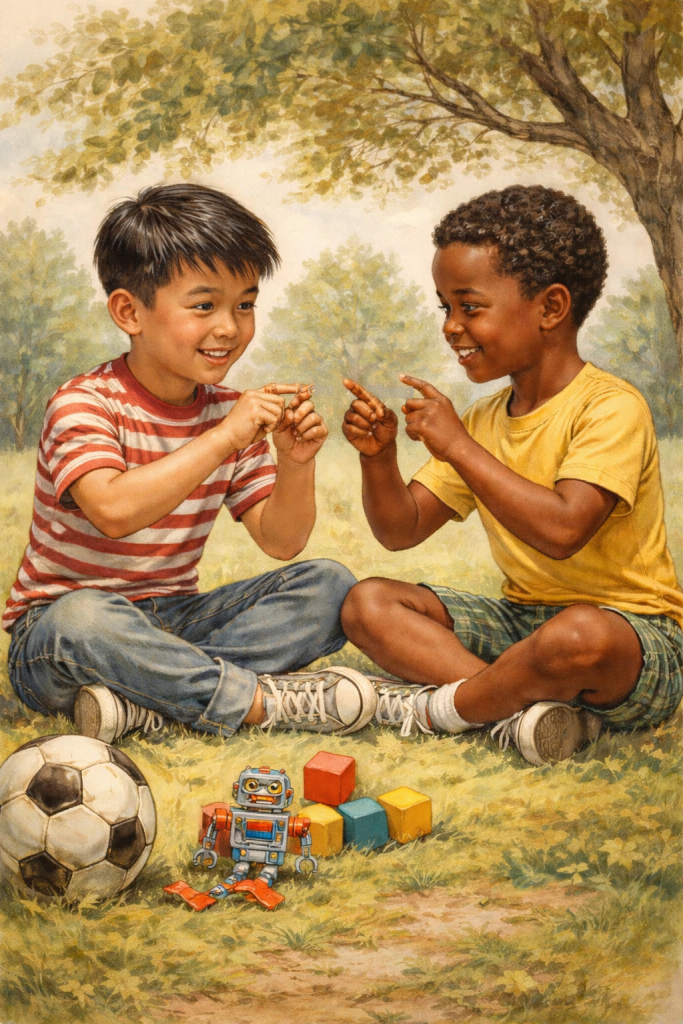
Deaf culture is not silence, it is a language with a heartbeat.
It is where language grows roots.
It is identity in motion.
It is a visible community.
Hello, my name is Bret, and I am Deaf. I have taught Deaf culture since 1998 across colleges around the country. Bridging Deaf and hearing communities has never been just a job for me, it has always been my passion.
And for Deaf children, that village must speak the language.
People love to say, “it takes a village,” usually right before shrinking the village down to parents and a pamphlet. For Deaf children, that saying only holds weight if the village is real, visible, and language-accessible. Not symbolic. Not well-meaning. Not outsourced to a single interpreter or one exhausted adult.
A Deaf child does not grow in isolation. They grow in an ecosystem. Every interaction teaches them something about belonging, effort, power, and whose comfort matters. Language is the soil. Without it, nothing roots properly.
This is not just about the Deaf community showing up. It is about everyone around the child deciding that access is normal, shared, and non-negotiable.
Ten examples of what the proverbial village actually looks like:
- Parents who learn the language early and keep learning. Not dabbling. Not delaying. Language exposure cannot wait without consequence.
- Siblings who sign fluently, not reluctantly. Daily life needs access. Jokes, fights, and secrets included.
- Extended family who adapt instead of excusing themselves. Love without access still leaves a child working.
- Teachers who respect ASL as a full language. Not a tool. Not a bridge. A language with authority.
- Interpreters who are qualified and collaborative. Not placeholders. Professionals who center the child.
- Peers who communicate directly. Lowered expectations help no one. Children rise quickly.
- Schools that do not isolate access to one room. Access must follow the child everywhere.
- A Deaf child’s friends who learn to sign. Not as a favor. As a normal part of friendship.
- Community spaces where signing is normal. Language belongs wherever life happens.
- Deaf adults who are visible and valued. Not inspiration. Proof of a future.
A village is not a slogan. It is a system of daily choices. Deaf children notice who signs, who tries, who avoids eye contact, and who speaks over them anyway. They learn quickly where effort lives and where it does not.
If the village relies on one person to carry language, the village has failed.
My Final Reflection:
What often gets missed in conversations about Deaf children is that access shapes identity long before anyone names it. A child does not wake up one day knowing they were excluded. They feel it accumulate. In pauses. In laughter that happens too fast. In plans made just out of reach.
People assume resilience will fill the gaps. Children are adaptable, they say. They are. But adaptation under constant strain teaches lessons no one intends. It teaches that understanding is optional. That asking for access is inconvenient. That silence is safer than interruption.
A true village removes that burden early. It spreads responsibility so no single relationship carries the weight of communication. It makes language visible enough that the child never doubts their place in the room.
This is not about perfection. Everyone fumbles. Everyone mis-signs. That part does not harm a child. What harms them is watching adults choose comfort over connection again and again.
When a Deaf child grows up surrounded by accessible people, something quiet and powerful happens. They stop translating their existence. They stop apologizing for their needs. They grow into themselves without having to fight for the basics.
That is what a village does when it works. It does not make a child extraordinary. It lets them be ordinary, confident, and fully present.
And that should never be rare.
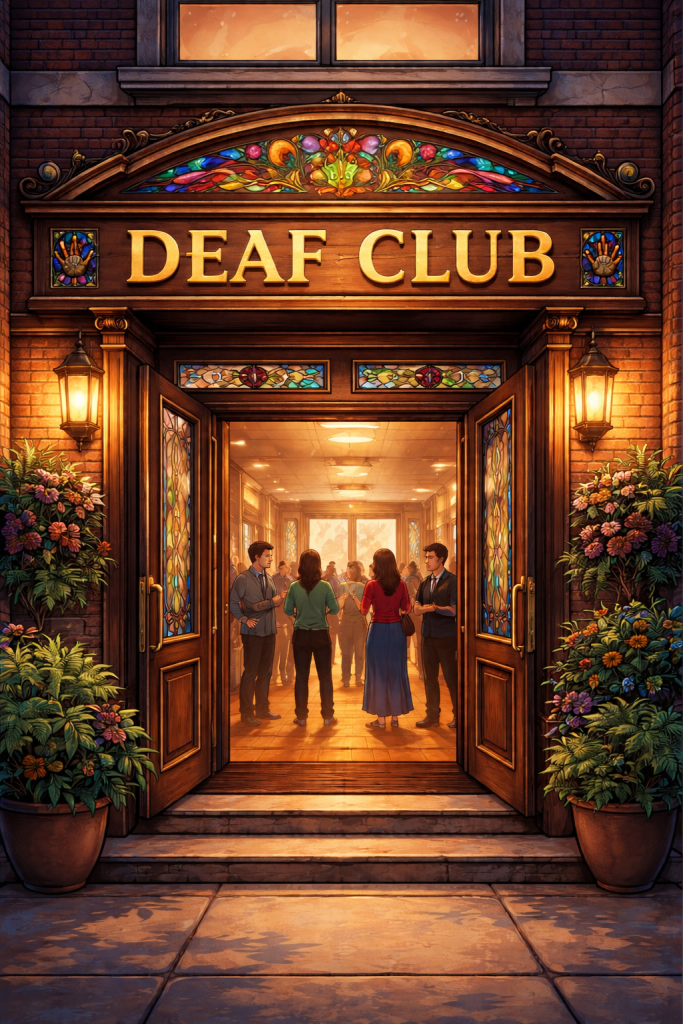
Are Deaf clubs closed to hearing people, or simply misunderstood?
Let’s change the lens for a moment.
This is not about general social inclusion or mixed spaces. This is specifically about Deaf Clubs and why they exist.
Short answer: sometimes, and there are good reasons.
Longer, honest answer: Deaf clubs are not built to exclude hearing people. They exist to give Deaf people something rare in a hearing-dominated world: a space where communication is effortless, culture is shared, and no one has to perform access.
From the outside, that can look like reluctance.
From the inside, it feels like relief.
Here are the main reasons hearing people may feel unwelcome, even when no one is trying to be unkind.
- Deaf clubs are not classrooms.
Many hearing people arrive hoping to practice ASL or be taught. Deaf clubs are social spaces, not free language labs. When someone shows up needing constant support, the burden shifts back onto Deaf people. That defeats the purpose.
- Power-imbalance fatigue is real.
Deaf people spend most of their lives accommodating hearing norms. Slowing down. Repeating. Explaining. At Deaf clubs, that labor stops. Some hearing visitors unintentionally bring it back.
- Language proficiency matters more than intention.
Good intentions do not guarantee smooth communication. English-based signing or frequent breakdowns disrupt the flow. People are there to connect, not to manage communication.
- History plays a role.
Deaf spaces have been monitored, controlled, and reshaped by hearing authorities for generations. That history leaves a long shadow. Caution is learned, not imagined.
- Inclusion looks different in Deaf culture.
Inclusion does not mean automatic access. It means earned trust. Showing up consistently. Watching more than talking. Respecting boundaries.
- Deaf Club bylaws exist to protect language, culture, and purpose, not to keep people out, but to keep the space true to why Deaf people created it in the first place.
Many Deaf Clubs have bylaws, not to exclude, but to protect what was intentionally built. Those guidelines exist because Deaf people set these spaces up with care, after generations of being misunderstood, overruled, or spoken for. The bylaws help preserve the club’s cultural focus, language integrity, and sense of shared responsibility. They are not barriers. They are guardrails, put in place to make sure the space continues to serve Deaf people first, the way it was meant to.
Yes, some Deaf clubs feel guarded. Not because hearing people are bad, but because the space has a job to do.
Here is the part that often gets missed.
Hearing people who are fluent, respectful, and community-oriented are often welcomed over time. Not as guests. Not as learners. As participants.
The unspoken rule is simple.
If you enter smaller than the language, the door stays open.
If you enter bigger than the language, it quietly closes.
A Deaf Club is not about keeping hearing people out.
It is about keeping Deaf people whole.
Whole means no splitting attention between language and survival.
Whole means no shrinking stories so someone else can keep up.
Whole means emotion, humor, anger, grief, and joy arriving intact.
Hearing people who understand this do not enter expecting access. They enter understanding that access is not the goal. Preservation is. They respect the purpose of the space before they ever ask to be part of it.
Over time, some are welcomed into the circle through relationship and responsibility. These are often CODAs, spouses or significant others, and interpreters who understand their role without needing to center it. They know when to listen without interpreting. When to watch without interrupting. When to step back without taking offense.
They do not arrive to practice.
They arrive to participate appropriately.
They do not extract language.
They protect it.
That is the difference.
A Deaf Club exists wherever the language belongs fully to the people using it, and no one has to ask permission to be understood. Deaf Clubs hold together for a specific purpose: collective survival through connection. They are not casual gatherings. They are cultural anchors. When Deaf people hold these spaces, they are not closing doors. They are holding the center steady so the language, the culture, and the people themselves remain whole.
Where Is the Deaf Club?
People keep asking, “Where is the Deaf Club?”
As if it is a building you can Google.
As if there is a front desk, business hours, and a blinking OPEN sign waiting just for them.
Here is the uncomfortable truth. Many Deaf clubs did close. Not because Deaf people stopped valuing community, but because the world around them shifted. Money dried up. Membership thinned. Leadership burned out. Technology changed how people connect. Social habits changed. Some clubs simply could not survive the pressure.
That loss is real. It matters. It still stings.
And it’s important to say this clearly. Not all Deaf clubs are gone. Some still exist, still open their doors, still hold space the old way. They survived because of committed members, steady leadership, financial grit, and a shared belief that physical gathering still matters. For those communities, the Deaf Club remains a living, breathing place. A building with lights on, chairs pulled out, and language filling the room without effort. Those clubs are not relics. They are victories. And for the people who still have them, that continuity is something to cherish, protect, and fight for.
But the story did not end there.
Examples: What “Club” Looks Like Now, Across Different Spaces
The Deaf Club did not disappear. It diversified. It adapted. It went where Deaf people already were.
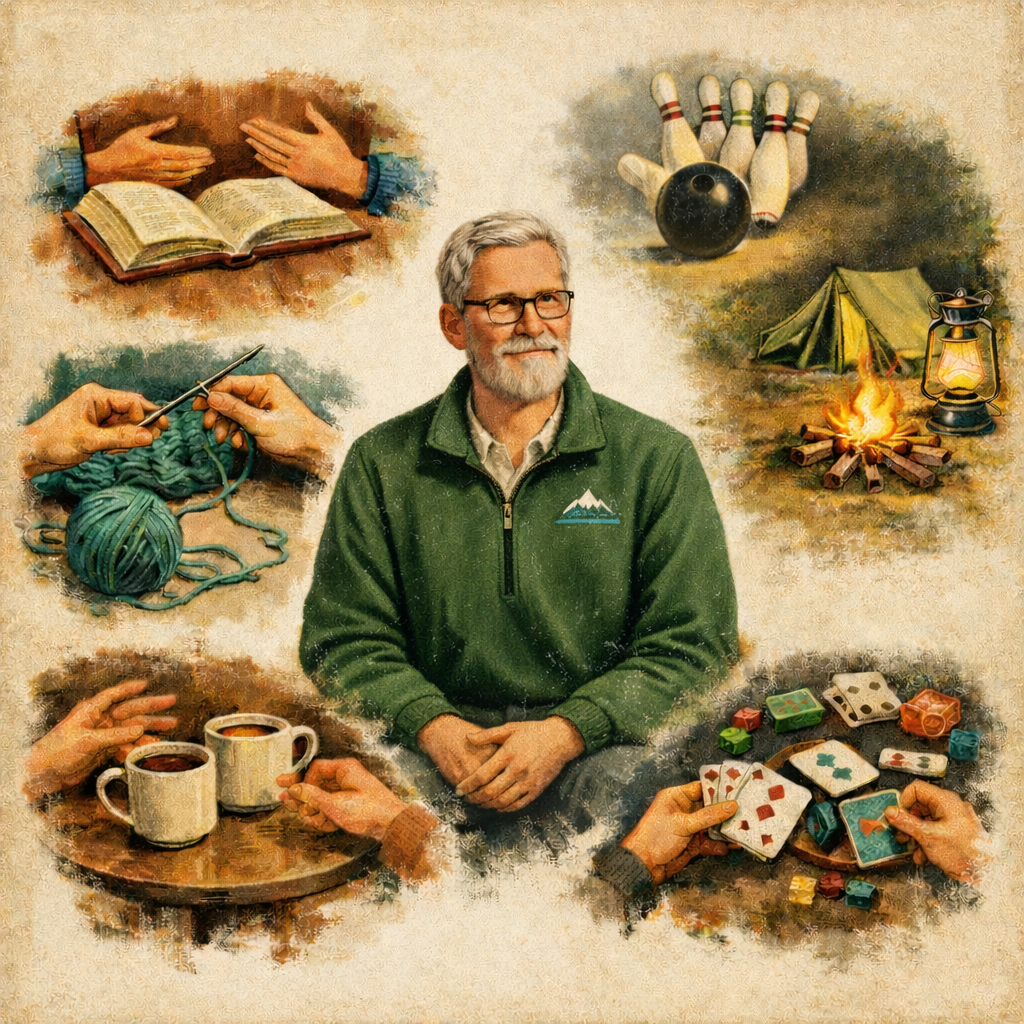
- ASL Club
A social space where students, signers, and community members gather to communicate, laugh, and exist in the language. All different levels of fluency.
- Bowling Club
Lanes, handshapes, shared jokes between frames. No microphones. No explaining. Just rhythm and community.
- Camping Club
Fires crackling. Stories told under headlamps and stars. Long conversations without the strain of lipreading or background noise.
- Crocheting Club
Hands busy, eyes engaged, conversation flowing. Language woven alongside yarn.
- Book Club
Stories discussed visually. Ideas passed hand to hand. Silence never mistaken for absence. One of Bret’s favorites.
- Coffee Club
Tables pushed together. Phones ignored. Time slows down because no one has to work to belong. Another one of Bret’s favorites.
- Game Night Club
Cards, board games, laughter. Rules signed once. Enjoyed all night.
Different names. Different activities. Same core truth. This is the Deaf Club, a form of survival shaped by how Deaf people have adapted to today’s world.
The mistake people make is thinking the Deaf Club is a place you go to learn. It is not. It is a place Deaf people go to rest.
When someone asks, “Where is the Deaf Club?” what they often mean is, “Where do Deaf people gather so I can spend time with them?”
That is a different question.
And it only works when it is paired with the understanding that community is built through participation, not location.
My Final Reflection:
The old model of the Deaf Club as a single building made sense in its time. It was a sanctuary in a world that offered very few. Losing those physical spaces hurt, and pretending otherwise would be dishonest. Buildings hold memories. Walls absorb language. Floors remember footsteps. When a club closes, history closes with it. Deaf people carry those moments with deep, heartfelt gratitude.
But Deaf community was never brick and mortar at its core. It was always language-first. People-first. Effort-free communication in a world that usually demands constant effort.
Technology and social change did not arrive without cost. They did harm Deaf clubs. They fractured routines, thinned membership, and pulled at the threads that once held physical spaces together. Many Deaf people carry real grief and anger about those losses, and that pain deserves to be named, not softened.
What followed was not indifference, but resiliency. Deaf people adapted under pressure. They reshaped community in ways that could survive changing economics, shifting habits, and a faster, more fragmented world. The Deaf Club did not vanish. It endured by transforming, even when that transformation was born from loss rather than choice.
Today, Deaf people build clubs around interests, not just institutions. Around shared joy, not obligation. Around sustainability, not nostalgia. If a space stops serving the community, the community moves. Quietly. Efficiently. Without asking permission.
That flexibility is not loss. It is survival.
So when someone says, “I cannot find the Deaf Club,” the honest answer is this.
You are probably looking for a door when you should be looking for a table.
A trail.
A bowling lane.
A circle of chairs.
The Deaf Club exists wherever Deaf people gather without having to explain themselves.
If you cannot see it, that does not mean it is gone. It means you are standing outside the language.
 Many Stories, Signed in Print