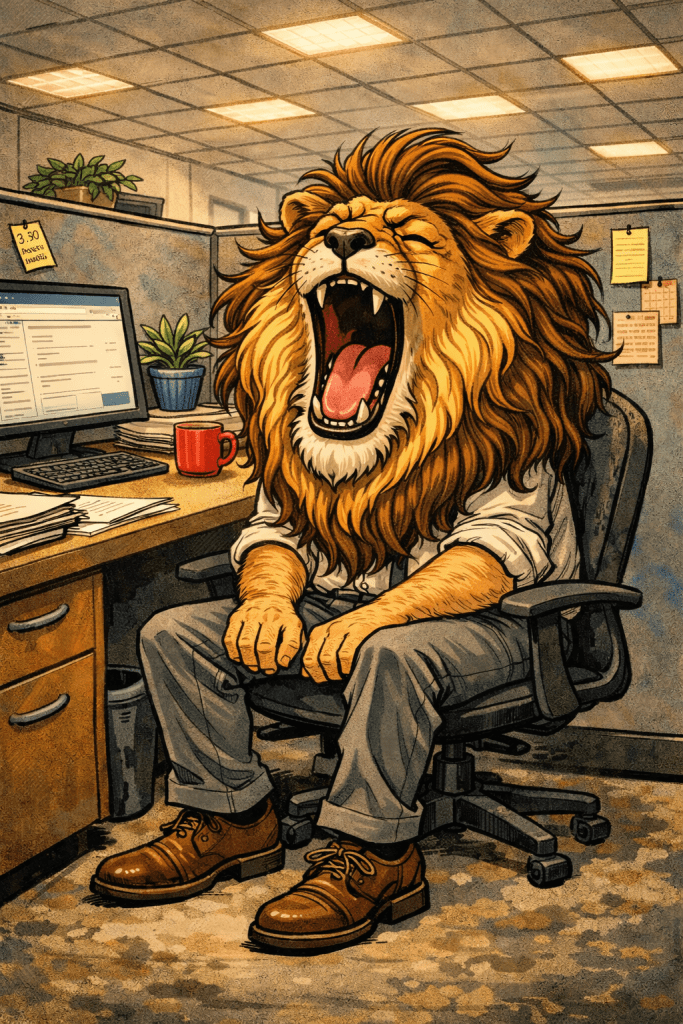
The Liawn
In the vast, carpeted plains of Office Land, where the lights never quite feel like sunlight and the clocks never quite tell the truth, there lives a creature most workers have felt but few have ever seen.
It has a thick, majestic mane, but instead of roaring, it releases a slow, rolling breath that sounds like the world stretching.
They call it the Liawn.
Half lion, half yawn, and entirely… underused.
The Liawn has the proud mane of a jungle king, wild and heavy, but its eyes carry the soft glaze of someone who has been sitting far too long with nothing meaningful to do. Where a real lion would roar, the Liawn exhales long, drifting breaths that ripple through the air like a warm sigh.
Liaaaaawwwnnn…
When that sound slips down a hallway, something subtle begins to happen. Spines straighten less. Fingers hover over keyboards. Coffee cups pause halfway to lips. The office does not fall asleep, not exactly, but it loosens, like a body finally realizing no one is watching.
The Liawn does not hunt gazelles.
It hunts underwork.
It pads between cubicles, stepping over tangled cords and unread sticky notes. It curls beside printers that have not printed anything important in weeks. It drapes its tail across stacks of paperwork that have been waiting for a reason to exist. Wherever it rests, fake urgency melts away.
Humans try to stay busy.
“I just need to check one more case,” they whisper, scrolling through empty queues.
The Liawn tilts its head and releases another yawn. That yawn slides into their shoulders, their jaw, their breath. Suddenly the word “urgent” feels imaginary. Suddenly the idea of pretending feels heavier than resting.
The copier sighs.
The inbox goes still.
The printer omniously blinked.
A spreadsheet forgets what it was calculating.
Even the fluorescent lights seem to soften.
Long ago, before calendars ruled everything, the Liawn roamed open plains and slept beneath real trees. But when humans captured time and trapped it inside cubicles, the Liawn followed, quietly, to keep them from turning into furniture.
People feel it before they see it.
Eyelids droop.
Minds wander.
Purpose begins to wobble.
The Liawn does not stalk danger.
It stalks emptiness disguised as productivity.
It curls around swivel chairs. It lies down on forgotten memos. Wherever it rests, the performance collapses into something slower and truer.
Workers whisper, like nervous gazelles.
“I just need to push through.”
The Liawn exhales. That breath loosens every clenched thought. Suddenly, nothing needs pushing.
The Liawn knows what most offices forgot.
Rest is not laziness.
Rest is what happens when pretending stops.
It stays only as long as needed. If it lingered, people might start imagining lives with walks, dogs, lakes, and long quiet afternoons.
So when screens go dark and the office hum fades, the Liawn stretches, mane glowing in monitor light, and slips back into the vents.
It leaves behind something rare.
Permission.
Permission to breathe.
Permission to pause.
Permission to be human.
If your chest opens with a slow, wandering yawn in the middle of a dull workday, do not fight it.
That is not weakness.
That is the Liawn brushing past your soul.
You yawned.
The Liawn noticed.
You are already transforming.
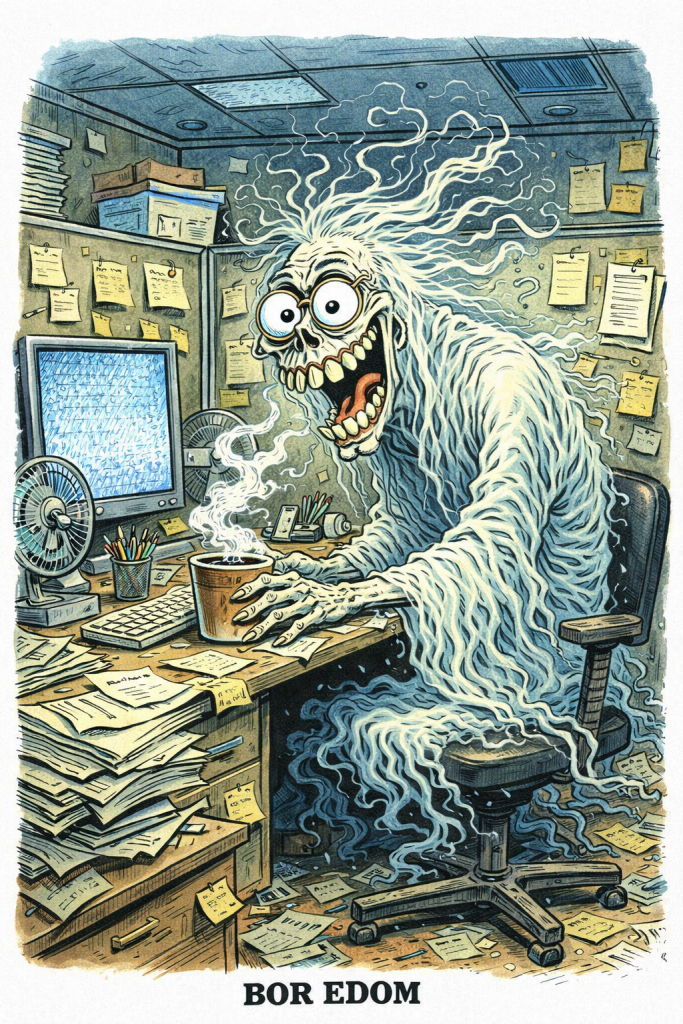
The Legend of Bor Edom
Grab a chair, hush your thoughts, and meet Bor Edom, the most dreaded ghost of workplace cubicle.
No one knows who Bor Edom was, but everyone at the office swears he haunts it.
Legend says Bor Edom once worked here back when cases were plentiful and coffee was strong enough to wake the dead. He was a tireless processor of files, a fearless stapler of documents, a man who believed in productivity the way monks believe in silence. Then one day, the cases stopped. One by one. Fewer emails. Fewer tasks. More waiting. More blinking at the screen.
Bor Edom waited too long.
They say he began counting things. Ceiling tiles. Keyboard keys. The hums in the fluorescent lights. Eventually he stopped speaking altogether, except to whisper, “Any new cases?” into the void. One afternoon, he leaned back in his chair, sighed, and quietly faded into a cubicle shadow. The office kept running. Bor Edom did not.
Now his ghost roams the halls.
You can feel him when the inbox stays empty too long. The air gets stale. The printer makes a sad cough. Your coffee goes cold faster than it should. Somewhere, a chair creaks even though no one sat down. That is Bor Edom, checking on you.
Sometimes he stands behind bored employees and whispers terrible thoughts.
“You could alphabetize that.”
“You could reorganize the paperclips.”
“You could stare at the wall and think about every life choice.”
He does not want you to suffer. He just wants company.
I swear I saw him the other day hovering near my cubicle, staring at my portable fan like it was forbidden magic. His ghostly eyes drifted toward my books, At the Coffee Shop of Curiosities and The Hiking Book from Hell, and for a moment, I felt pity for him. He never learned how to escape boredom. He let it take him.
Not me.
I write. I read. I drink radioactive coffee. I create sparks with my fingers. I refuse to become another office ghost.
Bor Edom can keep the empty hallways. I have stories.
And somewhere, deep in the vents, he sighs.
A world with no friction.
A mind screaming for texture.
A soul that refuses to go quiet.
Bor Edom did not fight it.
You did.
Some of you may wonder how’d he die of?
He died waiting for new cases. ☠️😲
 Many Stories, Signed in Print